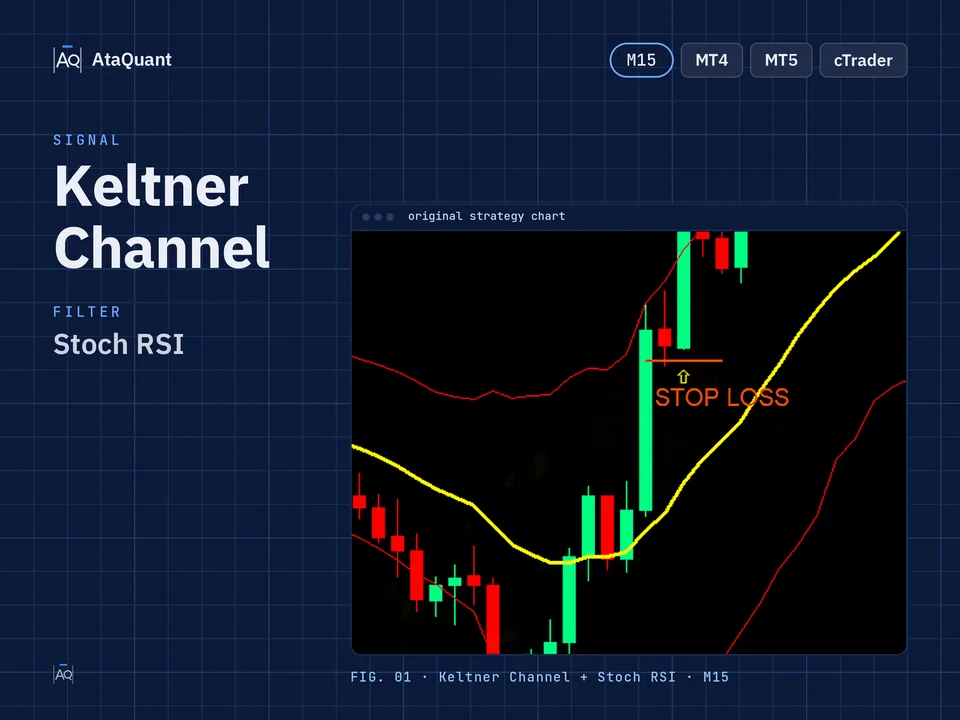
Keltner channel trading strategy
Boost your trading results with the Keltner Channel strategy — a powerful setup combining Keltner Channels, Stochastic RSI, and RSI confirmation. Optimized for the 15-minute time frame, it helps traders identify precise entries, follow the market trend, and manage risk consistently.

Ready-made EA for this strategy is provided below — scroll to purchase
◊ Introduction to the Keltner Channel Trading Strategy
The Keltner Channel indicator is a technical analysis tool. This indicator is very similar to the Bollinger Band indicator and consists of two upper and lower bands and a middle line.
Traders use this tool to determine market entry and exit points. One of the trading signals with the Keltner channel indicator is breaking the upper or lower bands and re-entering them.

In the following parts of this article, we will teach you a great strategy using the Keltner Channel and confirmation of two other trading tools that can be used in all financial markets.
Learn more:
1- The VWAP and RSI Trading Strategy
2- A Powerful Trading Strategy Utilizing the Half Trend, Stochastic, and RSI Indicators
◊ Indicators Used
Apply the Keltner Channel Indicator for entering the trade
The foundation for entering a trade is predicated on breaking either the upper or lower bands of this indicator and subsequently re-entering within the bands.
Use the Stochastic RSI Indicator
For entry confirmation
Use the RSI Oscillator Indicator
To confirm the trend and trade in the direction of the market trend

◊ The trading time frame of this strategy
The recommended time frame for using this strategy is 15 minutes.
Learn more:
1- RSI stochastic trading strategy
2- 5-Minute Scalping Strategy with Stochastic RSI
◊ Settings of indicators
All indicator settings remain at their default configurations, except for the RSI oscillator within the STYLE section, where the middle line should be made more colorful, with a value of 50, to enhance visibility.

Want to Automate this Strategy? Check out Ready-Made Expert Advisor here
◊ How to open a long position for using the Keltner Channel Setup
● Entry Rules
To make a long trade, the following conditions must be met:
The first condition- The price enters below the Keltner lower band.
The second condition- The lines of the stochastic indicator should be below line 20.
The third condition- The price returns to the upper of the Keltner lower band and closes.
The fourth condition- The stochastic indicator lines should be above line 20 but not above line 80.
The fifth condition- The RSI indicator is above 50.
By establishing these five conditions, we open a long position.
●Exit Rules
Stop Loss: We consider the lowest low after establishing the conditions as the stop loss.
Target or take profit: The profit of this trade is based on risk-to-reward, and the ratio of risk to reward can include one of the following, according to the riskiness of the trader:
1- One-to-one risk-to-reward (low-risk)
2- Risk to reward is one to one and a half (moderate risk)
3- Risk to reward one to two (high-risk)

◊ How to open a short position for using the Keltner Channel Setup
● Entry Rules
The following conditions must be met to complete the short trade:
The first condition- The price enters above the Keltner upper band.
The second condition is that the stochastic indicator lines should be above line 80.
The third condition- The price returns to the bottom of the Keltner upper band and gives a close.
The fourth condition- The lines of the stochastic indicator should be below line 80 but not below line 20.
Fifth condition- The RSI indicator should be below 50.
By establishing these five conditions, we open a short position.
●Exit Rules
Stop Loss: We consider the highest high after establishing the conditions as the stop loss.
Target or take profit: The profit of this trade is based on risk-to-reward, and the ratio of risk to reward can include one of the following, according to the riskiness of the trader:
1- One-to-one risk-to-reward (low-risk)
2- Risk to reward is one to one and a half (moderate risk)
3- Risk to reward one to two (high-risk)

Learn more:
1- Williams Percent Range Trading Strategy
2- An Easy-to-Follow RSI Trading Strategy
Note: The recommended time frame to use this strategy is 15 minutes.
Conclusion
The Keltner Channel trading strategy combines price action with momentum confirmation, providing traders with a structured and disciplined approach to identifying high-probability trade setups. By using the Keltner Channel as the primary signal for potential reversals or continuations and confirming entries with the Stochastic RSI and RSI indicators, this method reduces false signals and aligns trades with the prevailing market trend.
Its straightforward rules make it suitable for both beginner and experienced traders, particularly on the 15-minute time frame, where short-term movements are clearly visible. As with any trading strategy, effective risk management—through appropriate stop-loss placement and risk-to-reward ratios—is crucial to achieving consistent results. When applied with patience and discipline, the Keltner Channel strategy can serve as a reliable framework for building well-timed trades across various financial markets.
Looking for more? Discover our other forex trading strategies and see how they can fit your trading style.
Professional tools for every trader
From custom Expert Advisor development based on your unique ideas to ready-made EAs built on documented strategies – we’ve got you covered. Find the solution that fits your style in our EA Shop.
Visit our Expert Advisor Shop
Check out our Free Indicators here
The EA for this strategy
The rules above, coded as a ready-made Expert Advisor. See its inputs and platforms, or ask for a modification.